
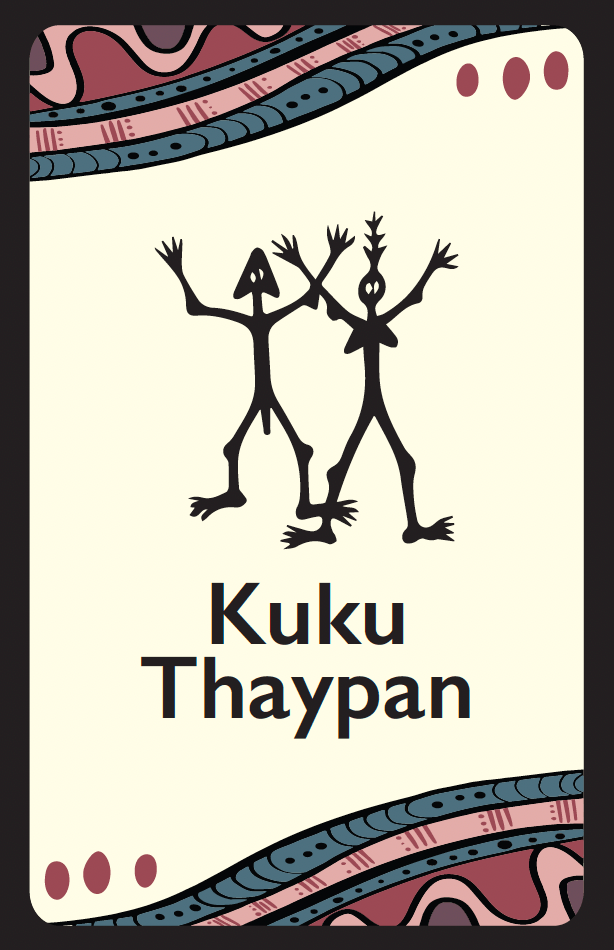
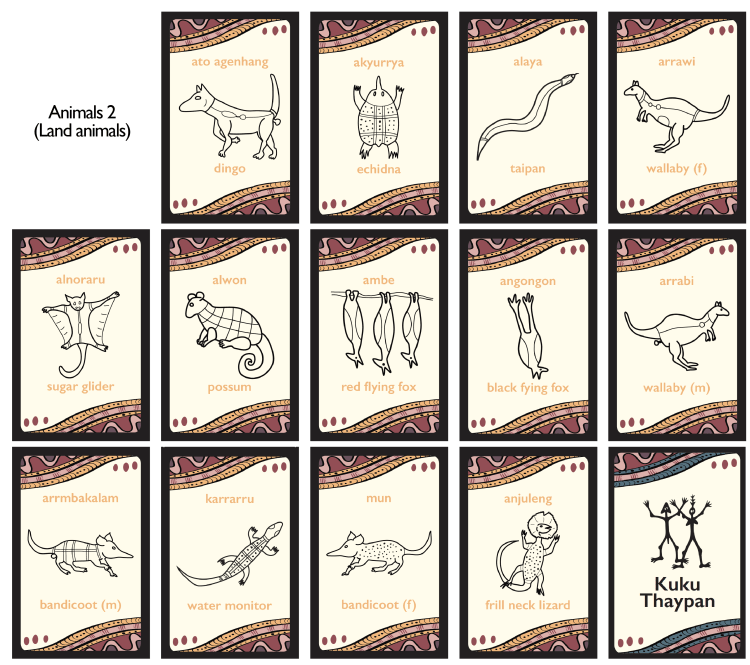
To assist people, especially teachers and local children at the Laura State School, to learn Kuku Thaypan, an Indigenous language of southeast Cape York Peninsula, Queensland, Australia, packs of ‘flash cards’ have been designed. Each pack of cards features 13 designs, replicated in four different colour designs. The designs show an image, with the corresponding word in Kuku Thaypan above the image and English below the image. As at 12 December 2024 there are four packs of cards: Animals 1 (water animals), Animals 2 (land animals), Birds 1, and Material Culture 1 (see below).
Users can play various games with the cards, including Go Fish, Snap and Memory (see below for instructions). In addition, there is an online app which helps card users to learn the correct pronunciation of the words in Kuku Thaypan and also to test their knowledge. To access the online version of the cards click here.
The cards are not only helping improve literacy, but are also promoting local Indigenous culture, increasing cultural awareness and providing a small income stream for local artists.
The Card Packs
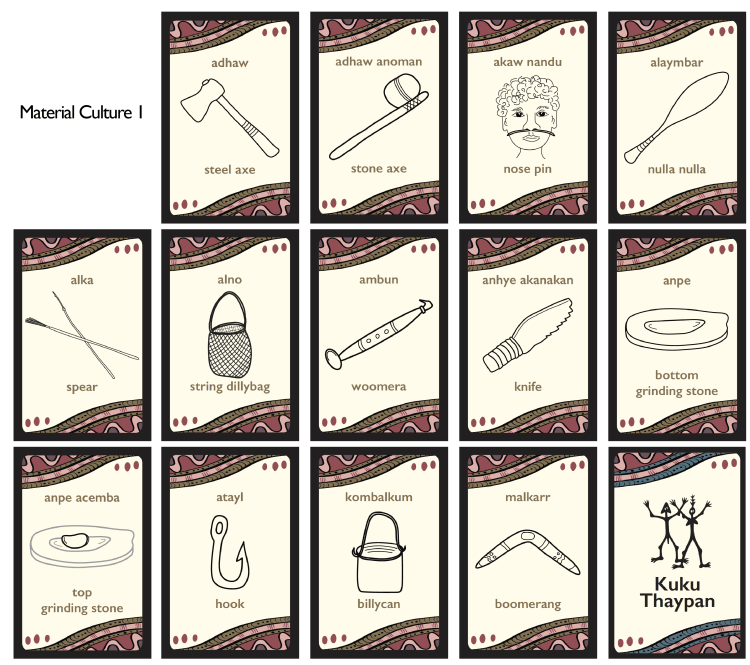
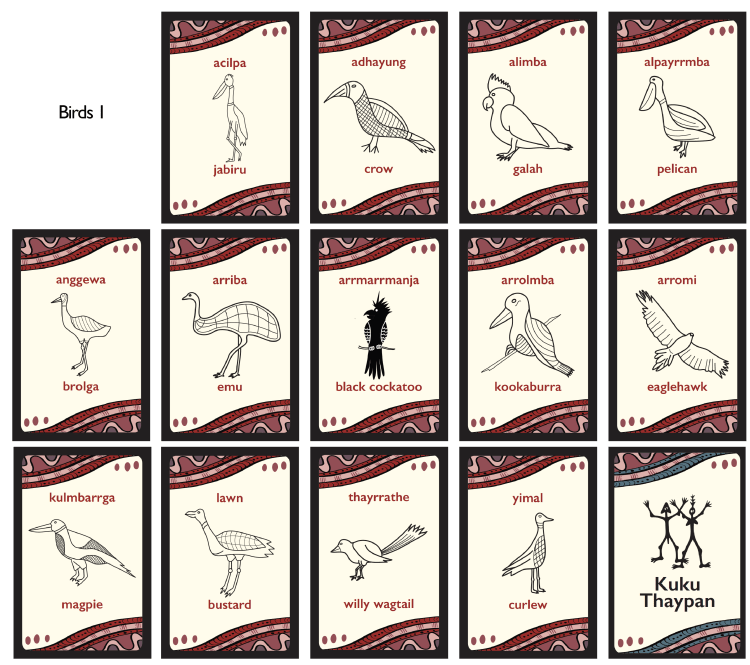
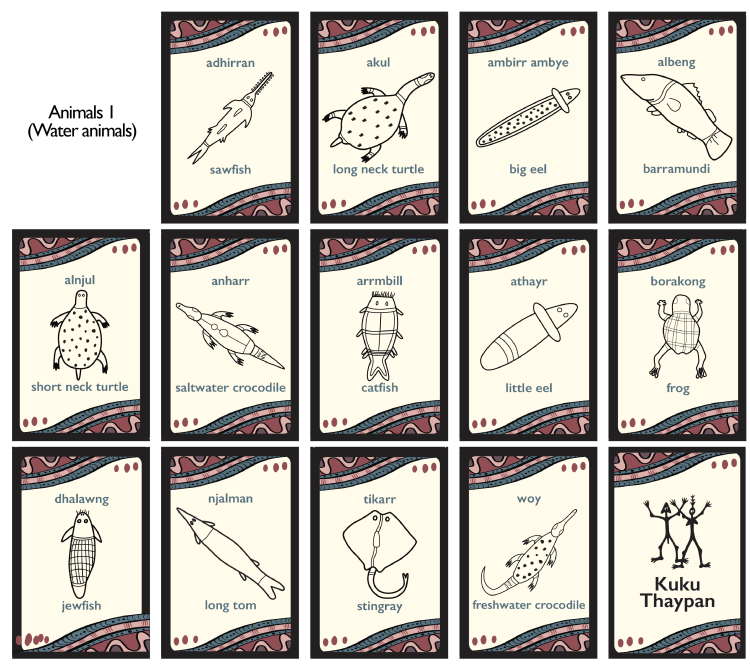
The Artists
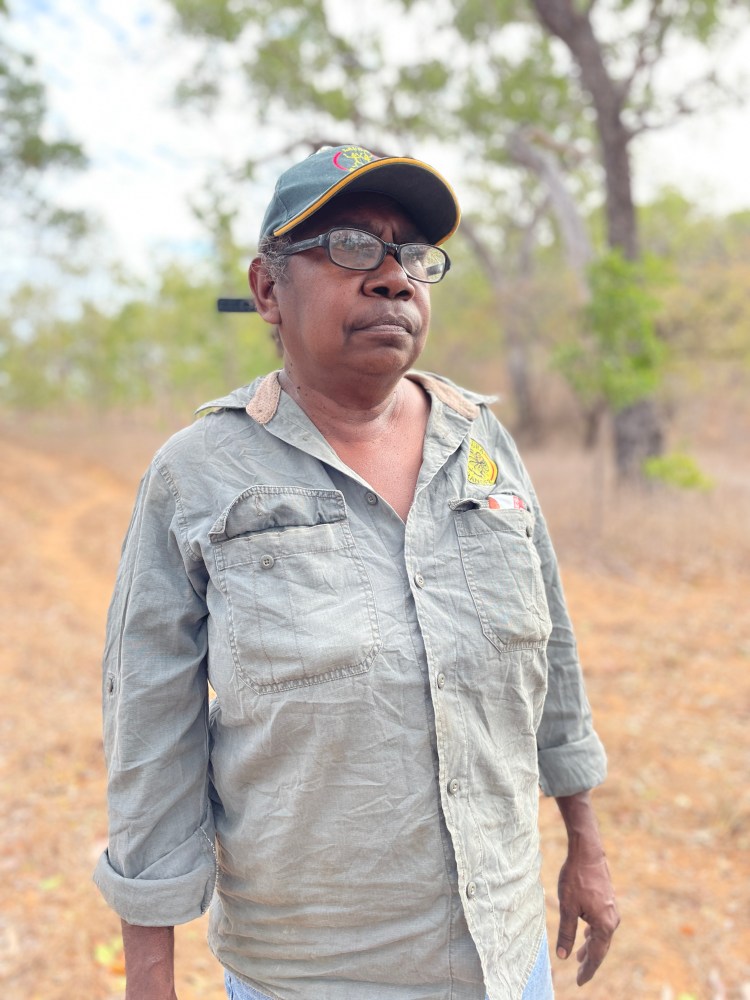
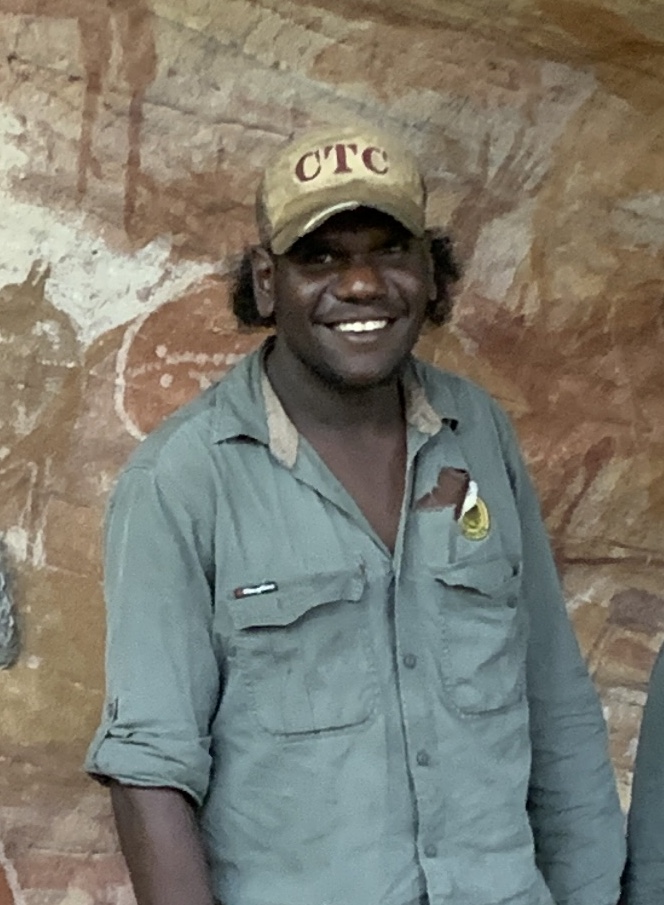
The artists who created the individual motifs shown on the various cards are Chrissy Musgrave and Palmer Lee Cheu, members of the Laura Rangers and traditional owners for Kuku Warra, Kuku Thaypan and Kuku Possum lands in south east Cape York Peninsula. The style of the motif designs are drawn from the local Quinkan style of rock art, which can be found painted in the 1000s of sandstone rockshelters around the township of Laura.
Chrissy is a senior member of the Ranger team, having worked tirelessly over decades to protect her traditional country and knowledge.
Palmer is a younger member of the Ranger team who has had longstanding interests in artistic endeavours.
The Games
Go Fish
The aim of Go Fish is to collect the most pairs of cards of the same type, and is a game played with 2 people or more. If a large number of people are playing, multiple packs of Kuku Thaypan cards can be joined to accommodate larger player groups, or to ensure the game goes for longer.
- Shuffle the cards. If up to 4 people are playing, deal them 7 cards each. If more than 4 people are playing then deal each player 5 cards.
- Place the rest of the cards in the middle, face side down.
- The player to the left of the dealer starts.
- The player asks any other player for a certain card. For example, I might say “Dylan, do you have any arrmbil?” If Dylan has any arrmbil he has to hand those cards over to me; if not, Dylan replies “Go fish”, and I have to pick up one card from the pile in the middle. But! You must already have at least one card in your hand before asking someone else for it. So I couldn’t ask Dylan for an arrmbil if I didn’t already have one in my hand.
- If a player “fishes” a card from another person they get another go. If they have to “go fish” then their turn is over and play moves to the next person.
- When a player has two cards of the same design, they can place them together on the table in a set.
- If a player has no more cards in their hand, then they may pick up 1 from the central pack and ask another player for a card of that type. If there are no more cards left in the pile then that player is out of the game.
Snap
The aim of Snap is to win all of the cards in a pack, and it can be played with 2 people or more. If a large number of people are playing, multiple packs of Kuku Thaypan cards can be joined to accommodate larger player groups, or to ensure the game goes for longer. The more people playing, the more chaotic the game!
- Shuffle the cards.
- Deal out all cards face down, one at a time, beginning to the dealer’s left. It does not matter if some players have more cards than others. Each player puts their cards in a pile, face down in front of them.
- The player on the dealer’s left turns over the top card of their pile and puts it face up starting a pile of cards next to their face down cards. The next player to the left does the same and so on around the table.
- When someone turns up a card that matches a card already face up on another player’s pile, the first person to notice the two matched cards calls out “Snap!” and wins both piles. This player adds the cards to the bottom of their face-down pile.
- When two players shout “Snap!” at the same time, the two piles are combined and placed in the center of the table face up. These cards form a “Snap Pot.” Play continues where it left off with the player to the left of the last player who turned over a card. If a player spots a card that matches the card on top of the Snap Pot, they shout “Snap Pot!” and win all of those cards. During the game, if a player runs out of cards in their face-down pile, the cards in the face up pile are turned down and the player continues to play.
Memory
The aim of the Memory card game is to collect the most pairs of cards. Memory should be played with at least players. While it can be played with a single pack of cards or multiple different packs of cards, it is ideally played with two packs of the same Kuku Thaypan designed cards.
When all of the cards have been matched, the game is over. Players count their pairs and the person with the most pairs wins.
Shuffle the cards and lay them out, face down, on the table or floor in rows.
The first player turns over two cards. If they match, the player gets to keep the cards and have another go; if they do not match the cards are turned over again and the player to the left takes a turn.
Each player must try to remember where they have seen cards, so they can use them to make a match.
Acknowledgements
We are very grateful to the following for their assistance in developing the Kuku Thaypan language cards and associated app:
- Vitalogy Foundation for their generous support of the local community and Laura and initiatives such as that that focus on culture, language, leaning and children.
- Federal Government funding through the Australian Heritage Grants Scheme (community consultations).
- The Laura Rangers and Elders from the Laura community for use of the local Quinkan logo.
- Descendants of Kuku Thaypan speaker Christmas Shepherd, who granted permission for language recordings made in the 1970s by Christmas with linguist Professor Bruce Rigsby to be used in developing the online app that accompanies these packs of cards.
- Creative agency Humanize Media, an incredible Indigenous business, for providing the baseline design artwork.
- Adelaide-based artist and archaeologist Maggie Moy for delivering a workshop in mid-2024 during which Chrissy and Palmer produced their illustrations.
- Allan Browning of Inov8 Design and Griffith University for developing the online resource, and Dr Gervase Tuxworth of Griffith University for working behind the scenes with Allan to develop the resources.
- Richard Turner Jones for last minute technical wizardry with InDesign.
- Deven Crawford, John Fletcher and Colourchiefs for advice and support with printing.
 cyprockart.org